Thursday, April 5, 2018

Biopolitics and Post-Colonialism and Purple Hibiscus, oh my!

Biopolitics and Post-colonialism: Purple Hibiscus
The colonial period has formed the development of many contemporary countries and territories. The superpowers determined the way of self-esteem and self-evaluation of many peoples. Their world perception was formed by the influence of those countries which were considered to be their owners. The postcolonial period started from the point when former colonies had to continue their development alone. However, they had not start from the very beginning because they had already had the heritage which was brought by the colonizers. The majority of peculiarities are described in the postcolonial literature and criticism. Here, I would like to look through this issue on the example of Black nations and their literature which arose during the postcolonial period.
Postcolonial criticism corresponds to the certain historical period. As stated by Lois Tyson (2006), “postcolonial criticism analyzes literature produced by cultures that developed in response to colonial domination,” from the very beginning to the present times. The main heritage of the colonizers is the English language which became the background for the creation of postcolonial literature. Thus, the writer Adichie, about who I will speak further, argued that  "what we represent is largely the result of colonialism, for example, the fact that I think in English" (Garner, 2004). For many, English was the first language in which they learned to write. The Nigerian writer Chinua Achebe once said concerning this issue: “For me, there is no other choice. I have been given the language, and I intend to use it” (Tyson, 2006). However, lots of pre-colonial cultural heritage have been lost through many generations of colonial domination. Significant attention is paid to the postcolonial feminist critics which are often the central issue of many literature works, such as Purple Hibiscus (2003) by Chimamanda Ngozi Adichie.
The development of the Nigerian literature started from the 1970s. In the 70-80s, the Nigerian novel has a critically realistic tendency connected with unfulfilled hopes for a better life and a comprehension of new negative tendencies in public life (duCille, 1996). The feeling of frustration among writers, an accusatory beginning in their work is a reaction of literature to new phenomena of social life. The novel Purple Hibiscus (2003) is a family novel in which the educational and didactic trend is traced. Most of them are related to the problem of the status of women in modern African society. The author defends the idea of the woman's inner freedom, her right to choose her place in the surrounding reality. The novel is the story of the life of the heroine, her family, where the father traditionally rules, demanding from his wife and children obedience and serving him as a master. These traces were mentioned by Tyson (2006). The novel tells the story of a Nigerian family against the backdrop of events unfolding in the country during the Abacha military regime in the mid-1990s. The inner development of the protagonists demonstrates the historical development of the postcolonial countries.
In such a way, the postcolonialism is brightly reflected in the belles-lettres. The thoughts, expectations, and actions are shown in the texts. The readers see the transformation of heroes which is the allusion to the transformations of the whole peoples. Thus, Kambili and Jaja go through the path from the silent oppressed by their tyrant father of teenagers to the spiritually strengthened young people who are ready to take responsibility for their family and intercede for their unhappy mother. In such a way, Adichie traces the origins of the newest social reality through the destinies of her heroes.


References
Adichie, C. N. (2004). Purple Hibiscus a novel. London: Fourth Estate.
DuCille, A. (1996). Skin Trade. Cambridge, MA: Harvard University Press.
Garner, C. (2004). Profile of Chimamanda Ngozi Adichie. London.
Tyson, L. (2006). Critical Theory Today: A User-friendly Guide. Milton Park, Abingdon, Oxon: Routledge.

Wednesday, April 4, 2018

A Powdered Pocahontas: Pocahontas II and Postcolonialism

Pocahontas II: Journey to a New World is an untimely straight to DVD sequel of Disney’s Pocahontas. And, in all honesty it’s a wreck. It stays true to what actually happened to Pocahontas in real life (kind of) by sending her to London with John Rolf after news of John Smith’s death. However, in real life she did not willingly go and willingly give in to being “civilized” like the Disney movie portrays. In real life, she died three years after arriving in England. But, anyhow, this movie did terrible in the box office, and is riddled with opportunities for Postcolonial Criticism.

For example, she is shown off to the King, but only after a huge makeover in which a character named Mrs. Jenkins sings a song entitled “Wait ‘till he sees you!” During this makeover, Mrs. Jenkins actually puts white powder on her face (changing her skin color to a lighter shade) and sings “He’ll [John Rolf] be so pleased you came down from the trees!” Implying that Pocahontas is a savage, as she and the people of England see her and is finally coming down from “the trees” to be civilized. Before her makeover, she is portrayed as incompetent and uncultured, as she attempts to wear a girdle as a hat etc. There’s a lot wrong with that song, but this part is pretty straightforward.
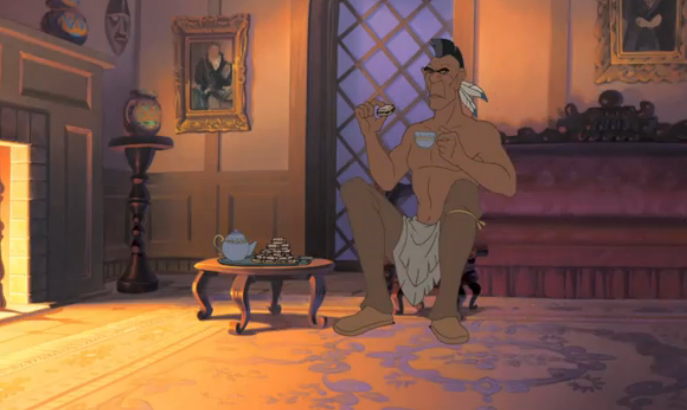
Yes, that is Pocahontas!
In the cartoon, Pocahontas comes to the England, and is promptly informed that she will be attending a ball during which she will be shown off to the King of England to show hi
m that the people of the New World “can be civilized.” She’s lied to and she thinks she is doing everything for peace between her people and John Rolf’s, but she is only being colonized and forced into a culture she really does not want. She

 After her makeover, both Mrs. Jenkins and John Rolf treat Pocahontas as a different person. She appears to be more “European” and hence, she is better, more civilized. This is a prime example of Eurocentrism, because it is clear that whoever wrote this movie, wanted England’s cultural practices to seem like the ultimate “culture standard to which other cultures are negatively contrasted” (Tyson 401). The King would not even see her until she was powdered up and strapped into a fancy ballgown, hence the Eurocentric way seems to win out.

All the English characters show blunt colonizer ideology too, as they all seem to think that their way is better, especially since they are “civilizing” this “savage Indian.” They just assume their way is better, especially John Rolf and Mrs. Jenkins who give her the makeover in the first place, and always treat her as if she were an ignorant child. Not to mention the way her body guard is portrayed, a Native American Character who does nothing but grunt, and follow Pocahontas around while wearing buffalo hide clothing. Obviously, he is meant to be seen as less than civilized. However, Pocahontas even gives in to these ideas of the colonizers by exhibiting mimicry in her willingness to be changed to a lighter skinned, strangely dressed Native American source of amusement (for much of the movie, she does eventually stand up. Not for herself though but for a bear who has been held captive.) She allows this to happen, and for the first part of the ball, (before saving the bear) she acts and talks just like John Rolf; truly becoming a colonial subject in England and making Mrs. Jenkins shed tears of joy. Furthermore, when John Rolff meets sees her for the first time in her new clothes, she explains to him that what is on her face is “called powder” and he exclaims how beautiful she is. For the first time in the movie, Pocahontas is told she looks beautiful by a man she loves, and in order for that to happen, her face has to be powdered lighter. Again, the colonizers and their ways are obviously portrayed as superior here.

Overall, the film is riddled with colonizer ideology, mimicry on Pocahontas’ part, and Eurocentrism through the way Pocahontas is portrayed and treated, and how she reacts

Saturday, March 10, 2018

New Historicism in “The Lottery”: Cold War Anxieties

“The Lottery” is a rather well known short story written by Shirley Jackson. The story revolves around a village performing their annual “lottery” that essentially decides who is going to be sacrificed so that the town will have a good harvest. The story was written in 1948 which locates it a few years after the end of World War II and in the beginning stages of the Cold War. This is a time when anxieties about the conflict are skyrocketing in both countries.
Simply locating the story within a timeframe is not enough for new Historicism though, as its goal is more complex. Tyson describes one of the ways new Historicism is distinguished from the traditional “New historicism is concerned not with historical events as events, but with the ways in which events are interpreted, with historical discourses, with ways of seeing the world and modes of meaning”(Tyson 278). “The Lottery” focuses on the anxieties and events surrounding the Cold War and Jackson uses them to show the  conflict and discourse between the U.S. government, and the average U.S. citizen of the time.
Shirley Jackson's "The Lottery"
The way that the lottery functions is that one of many strips of paper is marked with a black dot, and then they are all put into a specific black box which has been used for years, and then the next day the box is drawn from to select a family, and then a family member. The “winner” of the lottery is then stoned to death by every man, woman, and child of the village together. This system is the closest thing there is to an authority or system of government in the story. It is mentioned that there are other villages and that these villages also partake in the lottery, so it is not just a random phenomena. The lottery may reflect a general anxiety and distrust in fellow citizens felt among all at that time, but I believe it more specifically is referring to the government’s distrust among its population and those in power, and the beginning of Mccarthyism. The government was seeking to maintain an idealised version of the United States and the “American Lifestyle™” and through their attempts at protecting their conceptualization of the world, harmful laws and legal events occured. The villagers, on the other hand, are simply “victims of the machine” and only want to survive, and have enough crop to survive. Among the villagers there are even those who distrust the lottery and wish to end it “‘They do say,’ Mr. Adams said to Old Man Warner, who stood next to him, ‘that over in the north village they're talking of giving up the lottery’” (Jackson). Old Man Warner promptly replies that “There’s always been a lottery”(Jackson) and dismisses him. The villagers only partake in the lottery because they feel trapped, they have never known a life without it and believe that if they do not participate they will have insufficient crops to feed themselves. The villagers take part in the lottery for survival. Jackson interprets the U.S. population’s fear at the time of the potential conflict and contrasts it against the government’s idealized values and willfulness to strike against its own people through the conflict between the villagers and the tradition of the lottery. “‘It isn't fair, it isn't right,’ Mrs. Hutchinson screamed, and then they were upon her” (Jackson).


Thursday, March 8, 2018

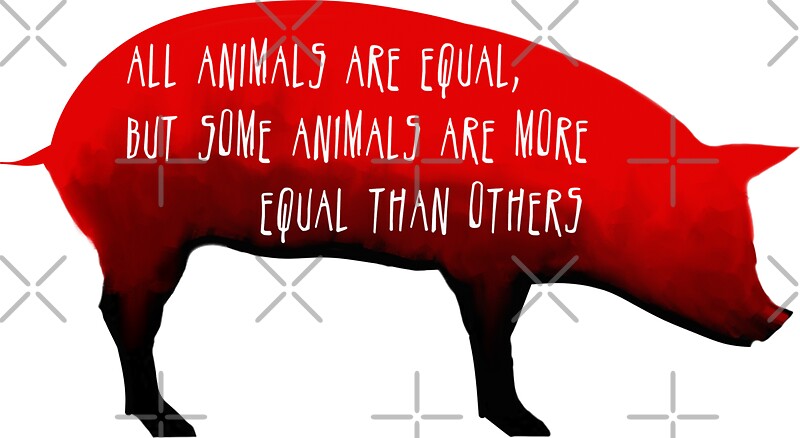
Communist Pigs: New Historicism in Animal Farm.


Tyson interprets New Historicism as what happens when we read a historical account and ask ourselves: “what does thus account tell us about the political and ideological conflicts of the culture that produced and read the account?” (Tyson 268). When New Historicism is applied to literary texts Tyson states that these texts are often viewed as “cultural artifacts that can tell us something about the interplay of discourses, the web of social meanings, operating in the time and place in which the text was written” (Tyson 277). When pondering both of these topics, the first example that came to my mind was George Orwell’s famous novel: Animal Farm. At first glance, Orwell’s novel seems to be about a bunch of animals who overthrow their farmer, fight for control, and ultimately just end up in a situation worse than what they came from. In a nutshell, that’s it; but if you do a deeper reading of the novel and apply New Historicist thought to it, traces of communism come out from the framework.

When we read the novel while keeping in mind “the political and ideological conflicts of the culture that produced” it and asking what the “interplay of discourses” within it might be we see the plucky pig leaders, Napoleon and Snowball in a different light. Written in 1945, a time when communism was striking fear in the hearts of many people throughout the world, Animal farm perfectly fits into the social discourse of post WWII/Cold war era Russia. The overthrow that the animals partake in against the humans is often seen as parallel to the communist revolution, and the pig that starts the revolution, Old Major, is often compared to Vladimir Lenin, the leader of the revolution in Russia. We also see reflections of other communist Russian leaders such as Joseph Stalin (Napoleon) and Leon Trovsky (Snowball) in the pig leaders who take over after Old Major’s death. We slowly start to see the discourse of communist Russia and the communist revolution play out through the characters of the animals, something that was heavy on many people’s hearts at the time of Animal Farm’s publication.

Thus, when reading Animal Farm with a new historicist point of view, we view it as a reflection of the political conflicts of communism in Russia in the 1940s. We see the “web of social meanings” in the way the pigs lead the animals in revolt, the way Napoleon overthrows his partner snowball, and in the way he changes the “Principles of Animalism” from their original purposes to a more sinister interpretation. By the end of the book, one pig has taken over the whole farm, (kind of like Stalin took over, but let’s not name names….) and the animals can’t see any difference in their post revolution farm from the pre-revolution version. This strikes a lot of similarities with communism at the time, because it certainly was nothing like anyone expected it to be. Just like communism spread and overtook several countries through one leader, the corruption of the pig Napoleon spread throughout the farm and he banished anyone who tired to stop him. Talk about a thirst for power. Overall, Animal Farm can be read in a new historicist light by the way in which it reflects the communist discourse of the time in which it was written (and takes the term "communist pigs" to a whole different level).


A Queer Theory Reading of Disney’s Mulan


            The animated film Mulan, released in 1998 by Disney, centers around a young Chinese girl who saves her father from being drafted into the army by taking the guise of a young man. The children’s film is based on the Chinese legend of Hua Mulan, a girl who also takes her father’s place in the army and goes to war for her country. A striking difference between the legend and the film, however, is that iterations of the folktale illustrate that Hua Mulan never claimed to be man; she went to war as a woman because she got bored of weaving, was victorious, and then returned home to continue weaving. Alternatively, Disney’s film focuses on a young girl who doesn’t fit in with her environment and is uncomfortable with the activities prescribed to her gender by her culture. Viewers follow Mulan and witness her question the masculine and female binary as she consistently performs somewhere in between the spectrum. A queer theory reading of Mulan shows how the film is capable of challenging the cultural notions of masculine and feminine and implicates the limitations of gender roles.
            The very beginning of the film introduces the customs and pageantry surrounded with becoming the ideal bride which establishes a role for women in society to the viewer. During the song “Honor To Us All,” Mulan is bathed, clothed, and painted with white makeup, rouge, and lip colour to show the elaborate process women must go through to be considered in good taste and desirable. Throughout the song, Mulan looks uncomfortable and lost as her elders continue to groom her making her appear more feminine and passive. When Mulan sees her reflection in the hand mirror presented to her, she is visibly shaken because she does not recognize the woman she sees in the mirror as being her. The makeup and clothes she is dressed in act as a metaphor for the mask she wears to hide her true identity. This instance contributes to our knowledge of queer work because it is akin to the roles people must perform when they do not fall into the category of gender roles or sexual identity. External expectations complicate the ability for individuals to self-actualize as is clear with Mulan. Ultimately, Mulan is acting to “keep [her] father standing tall” and bring honour to her family.
After being rejected by the matchmaker and disappointing her family, Mulan sings the song “Reflection” in which she laments her inability to be who she truly is. The sentiments she expresses are those longing to “show the world what’s inside [her] heart” and to escape “a world where [she has] to hide [her] heart and what [she] believe[s] in.” The imagery used in “Reflection” shows half of Mulan’s face without makeup (masculinity) and the other half painted (femininity) to show the binary opposition existing on the spectrum; queer theory works to break down these opposites. The lyrics of the song coupled with the image of Mulan’s face offer a look into the struggle of those who identify as genderqueer often endure because it shows conflict in coming to terms with one’s own identity. This process is made more complex when one identifies contrary to the expectations of society. More often than not, these individuals are met with judgement and vehement opposition. This is especially true in Mulan’s case where the punishment for a woman impersonating a man in the army is death.
                                           
The film explores other areas of queer theory such as homosocial behavior. When Mulan assumes the role of Ping, she develops an intimate but non-sexual relationship with General Li Shang whom she saves from death at the film’s climax. The initial relationship between both Shang and Ping at the training camp is one of tension. In many cases the tension is homoerotic, especially when a shirtless Shang stares at Ping. A queer theory reading likely would attribute this tension to the problematics of sexuality or sexual identity. Sheng’s song “I’ll Make A Man Out Of You” indicate he subscribes to heteronormative culture. His attraction to Ping conflicts with his heterosexual/hyper-masculine self-schema. As the film progresses, Shang grows closer to Ping. After Ping is revealed to be Mulan, a woman, Sheng is disgusted with himself and with the deception, realizing his sexuality may not be as clear-cut as he had once thought. At the end of the film, Sheng and Mulan are suggested to be romantically involved after she returns to life as a woman. This example illustrates that Sheng was appealed to by the masculine qualities of Ping/Mulan and continued to pursue Mulan in spite of this. This situation presented by the movie may serve as an effective example of a deconstruction of rigid binaries that society has constructed for women/men and homosexuals/heterosexuals that are a focus of queer theory.
                           
Other instances in the film such as the communal male bath, the “effeminate” male advisor to the emperor, and male warriors in drag promote themes that question what gender roles and human sexuality serve as a whole. Offered here is a taste of how these themes are initially explored in Disney’s Mulan. Upon closer examination of these other situations, a more complex look into queer theory can be obtained. Furthermore, this film can offer the opportunity to discuss the issue of “gender is performance” and transgendered identity. It is under these lenses one can learn how a person can have multiple identities rather than be limited to categorization. As a children’s film under this light, Mulan has the potential to facilitate an appropriate discussion and education about acceptance and diversity at a young age.

 Song Lyrics: Mulan, www.fpx.de/fp/Disney/Lyrics/Mulan.html. 
               

"The Two": How Lesbianism Challenges the Phallocentric Worldview

"The Two" an examination of a story from The Women of Brewster Place 

Women in our society are treated as objects with which to reaffirm the phallocentric male ego, so often that it’s hard to remember the deep vastness of women’s lives go beyond the men who define themselves by filling a hole that exists only in the intrigue of their own minds. Given the pervasiveness of the patriarchy, it’s rare to find even a single female character who isn’t defined in relation to the men in her life, much less a whole book filled with their stories, but that is exactly what Gloria Naylor gifts us with her debut novel The Women of Brewster Place. The stories of seven minority women defined by the healing bonds that form among them. I could and would happily discuss the ways in which the Lesbian Continuum defines each of these relationships, but in the interest of conciseness let’s focus our microscope upon Lorraine and her partner Theresa, the only ‘openly’ lesbian characters in the novel and the ways in which their relationship challenges the phallocentrism of the society in which the story is set.
Lorraine isn’t by any stretch of the imagination the ideal strong female character(™), who opposes masculine domination. Her life just isn’t about men. Since coming out and losing the support of her family in the process, her life has been geared toward her passions: being an educator and Theresa’s happiness. Unfortunately the two are at times at odds, due to the era (the 1970’s) she lives in and the conservative crusade, a witch-hunt against LGBT teachers in primary education, that began within it. She’s caught in the Epistemology of the closet, wanting to be out with Theresa (an advocate of unapologetically being who you are), but having to stay put behind the closet doors to avoid the social and financial ramifications of her orientation. She already lost a job to discrimination, once she simply can’t risk it again. Really that’s how they end up in Brewster. It was supposed to be a safe place to hide, from a disapproving society.
Clip of Lorraine and Theresa The Women of Brewster Place movie adaptation by Oprah
But even there in the outskirts, phallocentrism reigned in the image of one, C.C. Baker. A boy whose entire self worth rested between his legs.
"C.C. Baker was greatly disturbed by the thought of Lorraine. He knew of only one way to deal with women other than his mother. Before he had learned exactly how women gave birth, he knew how to please or punish or extract favors from them by the execution of what lay curled behind his fly. It was his lifeline to the part of his being that sheltered his self-respect. And the thought of any woman who lay beyond the length of its power was a threat."
"A threat" to the existing power structure, for how can a man assert his worth, his control over someone who doesn't fall prey to that which they have allowed to define their person-hood. I'd like to say that this quiet imbalance of C.C. Baker's world didn't have lasting ramifications on anyone beyond himself, but the system seeks to crush all those who defy it. Lorraine's life was not about men, but her society was a male dominated one. C.C. and his little crew hunted her down and raped her. She died from internal injuries. They had ripped her seam from seam, all to prove the power of their pathetic little penises.
          The world is an ugly place. The Patriarchy is ugly, it compresses men and women alike down to nothing more than their genitals and perpetuates a cycle of violence against women. That's why novels like The Women of Brewster Place and characters like Lorraine and Theresa matter so much, because they say we are more than a hole, we are people.

New Historicism in "Do Not Stand at My Grave and Weep"

“Do Not Stand at My Grave and Weep”
by Mary Elizabeth Frye
Do not stand at my grave and weep
I am not there; I do not sleep.
I am a thousand winds that blow,
I am the diamond glints on snow,
I am the sun on ripened grain,
I am the gentle autumn rain.
When you awaken in the morning's hush
I am the swift uplifting rush
Of quiet birds in circled flight.
I am the soft stars that shine at night.
Do not stand at my grave and cry,
I am not there; I did not die.

New Historicism in “Do Not Stand at My Grave and Weep”
Mary Elizabeth Frye’s “Do Not Stand at My Grave and Weep,” arguably the most famous poem about death in human history, benefits from a New Historicist reading because it was based on her personal experiences, written for a friend in need, and revealed in a particularly precarious, poignant time.
            In order to get to the real business of New Historicism—figuring out how a work comments on and relates to the historical and sociocultural contexts behind it—interpreters first have to know what those contexts are (“New Historicism”). Historically, this 1932 masterpiece was created in an unsafe global setting. In Germany, there was growing anti-Semitic unrest resulting from the prolonged national economic crises produced by World War I beginning nearly two decades earlier (“What Happened in 1932”). The United States was no stranger to financial trouble, either, with the Great Depression lasting from 1929 through 1939 in full swing and unemployment affecting an astonishing 24 percent of the total domestic population (“What Happened in 1932”). Meanwhile, in India, paragon of peace Mahatma Ghandi was just settling into his cozy jail cell after the current British regime, which did not agree with his plans for Indian independence, had performed one of the many arrests that would define his story (“What Happened in 1932”). To top it all off, in Russia, agricultural policies were causing mass starvation and death (“What Happened in 1932”). Discrimination, poverty, oppression, and suffering were a common international theme.
            Consequently, then, the socially relevant background Frye provided, in being well-equipped to live in such a difficult era, contributed significantly to her concise masterpiece. Orphaned at age three, she had been compelled to endure harsh struggle prior to finding happiness as a successful housewife and florist, developing both noteworthy compassion and resilience (Bates). She and her husband hosted their German Jewish friend Margaret Schwarzkopf at their home the year she suddenly became a poet (Bates). While staying, Schwarzkopf, subsequent to discovering that her mother was severely ill in Germany, felt distraught over being unable to travel to her side in the midst of the reigning unstable political conditions—especially the resentment against Jews fermenting in that country (Bates). Once her mother died due to her sickness, the poor woman told Frye that she wished she could be at the graveside to shed a tear there (Bates). Since Frye understood her visitor’s exquisite pain and the effort implicated in continuing with life following tragedy, she was immediately inspired to jot down “Do Not Stand at My Grave and Weep” on a brown paper shopping bag (Bates).
            Of course, although Frye did not intend to design a masterwork with stunning kairos—a soothing reminder that the memories of those who have passed on remain with their surviving loved ones, or “[do] not die” (Frye 12), and are resurrected in simple environmental instances of beauty—that helped to heal broken hearts around the world, she did (Bates). In gracefully expressing that the happinesses the dead have nurtured in their grieving companions are brought to mind by everyday spectacles in nature, like light sparkling on snow (Frye 4), she gave them a new perspective with which to withstand their challenges: an acknowledgement that, despite the fact that someone dearly beloved dying, and deep misfortunes as a whole, must sometimes be accepted, how survivors move on is a personal choice. Their most positive, and likely ultimately healthy and productive, option is to celebrate the time that they were blessed with the deceased’s presence—smile at the small miracle of a soft patter of rain outside their windows (Frye 6). Frye’s writing to comfort and encourage a buddy ended up being a universal coping tool.
            Jews in Germany already starting to confront the unearned bitterness that would later, in the unspeakable horrors of the Holocaust characterizing World War II, hurt them still more; destitute families in shanty towns across America; mistreated Indians crying for a nonviolent hero championing freedom and forced to exist behind bars; and overworked Russians praying for their next meals each benefitted from the determined hope that Frye communicates in “Do Not Stand at My Grave and Weep.” And in the twenty-first century, diverse nations are continuing to do so.

Works Cited
Bates, Jordan. “The Most Celebrated Meditation on Death in Human History.” HighExistence.com, highexistence.com/do-not-stand-at-my-grave-and-weep-mary-elizabeth-frye-death-poem/.
Frye, Mary Elizabeth. “‘Do Not Stand at My Grave and Weep.’” FamilyFriendPoems.com, www.familyfriendpoems.com/poem/do-not-stand-by-my-grave-and-weep-by-mary-elizabeth-frye.
“New Historicism Introduction.” Shmoop.com, Shmoop, www.shmoop.com/new-historicism/.
“What Happened in 1932: Important News and Events, Key Technology, and Popular Culture.” ThePeopleHistory.com, www.thepeoplehistory.com/1932.html.